
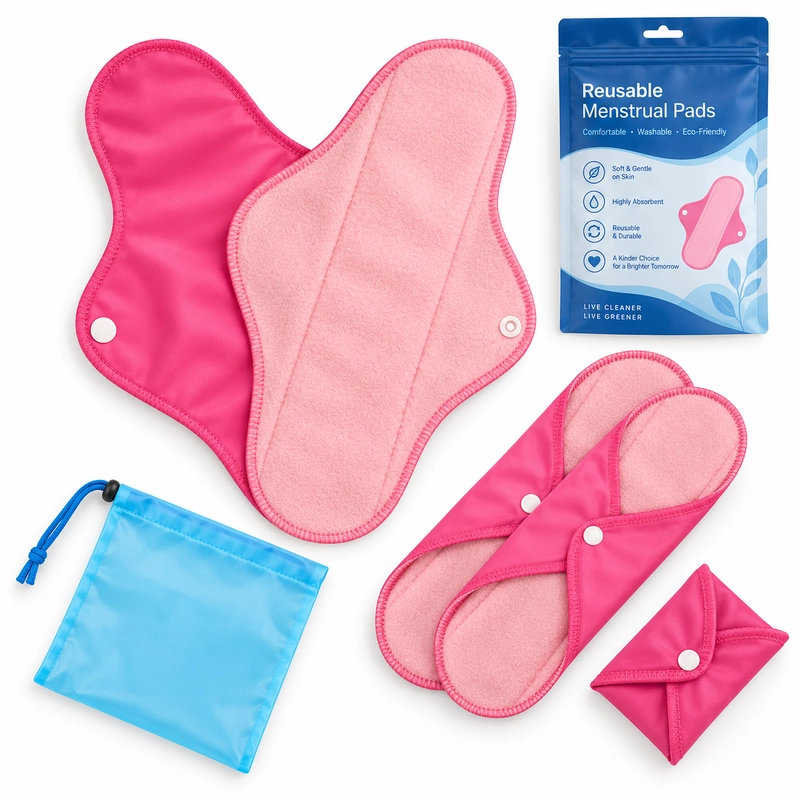
The 100, 250 and 500-piece scenarios help compare launch plans; they do not establish a price, universal MOQ or confirmed mixed-style order. ReuseCare lists basic finished-style minimums from 5 to 300 pieces depending on product; finished-product custom printing starts from 300 pieces. Confirm the applicable minimum for each selected style and decoration route.
Define what the quantity counts
A buyer may compare 100, 250 and 500 finished pads to understand launch scale, but the supplier needs a product and a quantity by version. State whether the number means individual pads, sets or another sellable unit. Then split it by day/night style, size or other variant, color or print. A 500-piece total could mean one style or several; those scenarios can have different assumptions even when the total is unchanged.
Keep the product brief constant across the three scenarios. If the smallest plan uses an existing style and the largest adds custom artwork and printed packaging, the difference cannot be attributed to volume alone. Ask whether the minimum applies per style, print, artwork, pouch or combined order. The day-versus-night guide helps describe the variants first.
Plan the day/night allocation
Do not request “a mix” without quantities. Give each version its own line and state intended use, requested coverage, material preferences, closure and details still to confirm. Day and night are use labels, not a universal standard for dimensions or absorbency. If a technical field is open, mark it “supplier to propose” and ask for the proposal to be recorded against the sample.
For each total, you can test alternative allocations while keeping the overall quantity fixed. Ask whether the styles may be combined and whether each has its own minimum or artwork route. A retail pack may contain one item or a set, and pack formats vary by product; require the quote to state exactly what one sellable unit includes. See the packaging guide for pack-content and artwork fields.
Compare the three planning scenarios
Specific route for this reusable menstrual pad: for 100–250 pieces, ask about ready stock; the stock option uses white snaps and depends on current availability. The custom route for this pad has an MOQ of 500 pieces and offers snap color selection, including gold. This is not a sitewide MOQ. Confirm inventory, style, colors and whether any requested mix can be supplied for each order.
Ready-stock vs. custom
Ready-stock, 100–250 pieces: ask which available stock style and quantity can be offered, with white snaps. Confirm current stock, selected style, color details and mix eligibility. Custom, 500-piece MOQ: specify the pad style and chosen snap color, including gold if preferred; confirm all order details and any additional customization with the supplier.
100 pieces: Ask which existing styles and standard presentation can be quoted at this quantity. List the day/night split and samples separately. If a requested print or packaging route has a minimum that does not fit, ask what alternative route is available rather than assuming the work is included.
250 pieces: Confirm whether the planned variants share a minimum or whether each style is counted separately. If finished-product custom printing is requested, note that ReuseCare's stated starting point is 300 pieces and ask how it applies to the specific product and method. A logo label or other decoration may follow a different route; confirm it.
500 pieces: Provide the allocation, artwork versions, package variations and pouch count line by line. Ask whether the proposed split changes carton configuration, labeling, sampling or schedule. A larger total does not automatically confirm that every variant can be combined under one minimum.
Quote optional pouches as their own line
Specify pouch quantity separately from pads. State whether it carries clean pads, used pads or both, and give a capacity target for supplier confirmation. Include material positions, closure, branding and packaging if known. If every retail set includes a pouch, state the ratio and ask the supplier to confirm the resulting piece count. For optional add-ons, quote a separate quantity scenario.
Ask the supplier to identify the pouch style, minimum, sample need and freight assumptions independently. Do not assume it is included or identical across pad sets. The pouch specification guide explains why material claims alone do not establish finished-pouch containment.
Keep customization, artwork and samples comparable
Identify the route for each scenario: existing finished style, label, logo application, finished-product custom printing or a combination requiring review. Finished-product custom printing starts from 300 pieces at ReuseCare; confirm the threshold for the exact selected product and method. Give artwork and logo files a revision identifier, placement and proof approver so all suppliers quote the same request.
Separate physical product samples from artwork and packaging proofs. List the day/night versions and pouch to be reviewed, sample quantities, revisions and destination. Ask for sample and shipping charges as quote fields and whether any credit applies; do not assume. Before production, link the approved sample version to the style split, artwork and pack contents. See the sample workflow and logo options guide.
Like-for-like quote worksheet
For this product, include the requested tier (100–250-piece ready stock or 500-piece custom), selected style, quantity by style, white snap for stock or requested custom snap color (gold is available), and any proposed mix. Ask the supplier to confirm current inventory, color availability, MOQ basis and style/mix eligibility. These terms apply to this pad only; do not assume one sitewide MOQ.
Copy these fields into each supplier request and duplicate them for the 100, 250 and 500-piece scenarios. If an answer is unknown, ask the supplier to state assumptions and mark it for confirmation.
Request separate quote lines for product, pouch, samples, branding, packaging and transport. Use the same specification and destination for each scenario. A combined total, estimate without freight and delivered quote are not comparable unless the supplier identifies inclusions and exclusions.
Confirm cartons and delivery scope
Ask for the proposed carton count, outer dimensions, gross weight and pack quantity after product and packaging are selected. These cannot be inferred from pad count alone; a pouch, gift box or mixed-style configuration can change the packing plan. Give the destination country and postal code, preferred method if known and requested trade term.
Ask where the freight quote ends and whether duties, VAT, brokerage or local delivery are excluded. The buyer or importer should verify applicable import charges for the shipment. Confirmed in-stock styles may dispatch within two days after availability is confirmed; dispatch is not delivery. Ask suppliers to separate sample, approval, custom production, dispatch and transit timing.
Choose a first-run plan from confirmed terms
Choose a scenario that matches actual buyer commitments and your tolerance for stock exposure. A smaller plan may suit standard products, while a larger plan may make a requested customization route possible; neither is always cheaper or better. Compare the proposed products and assumptions before the headline total. Make sure the quoted split, approved samples and packing instructions agree before releasing an order.
For the specific pad route, use the gold snap button guide. Use the existing-design private-label guide for stock versus custom planning, the 500-piece quote guide for cost drivers, and the MOQ and timing guide to clarify supplier replies. Send all tiers, allocations, pouch quantities and destination through the quote form.
Frequently asked questions
Are 100, 250 and 500 pieces ReuseCare's price or MOQ tiers?
No. They are hypothetical buyer planning quantities for comparing a project. Basic finished-style MOQs range from 5 to 300 pieces depending on product, and finished-product custom printing starts from 300 pieces. Confirm the applicable minimum and quote for each selected style and customization.
Can I combine day and night pad quantities in one order?
Ask the supplier to confirm whether the selected styles can be combined and whether each style, print or other variant has its own minimum. List the quantity for each version separately and have the quote state its MOQ basis.
How should optional waterproof pouches be included in the quote?
List pouches as a separate line with the requested quantity, intended use, specification status, branding, packaging and destination. Confirm the pouch's own style, minimum, sample and freight assumptions rather than treating it as included with pads.
What information makes 100, 250 and 500-piece quotes comparable?
Use the same style split, specification, customization route, artwork revision, packaging, sample scope, carton data, destination and quote exclusions for each scenario. Ask suppliers to itemize product, branding, packaging, sample and freight lines and confirm taxes or import charges separately.