
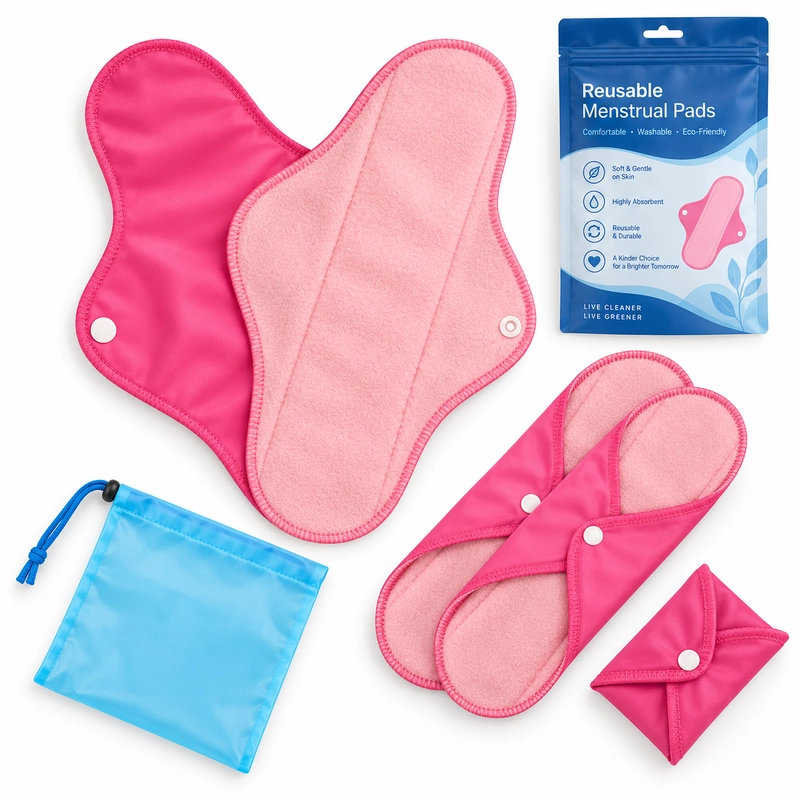
There is no dependable universal price for “500 custom pads.” Compare quotes only after suppliers price the same style, variant mix, material and construction brief, branding, individual packaging and destination. Ask for sample, product, customization, packing and freight as separate lines, and clarify any import charges. Five hundred is the planning example here; it is not a confirmed MOQ.
Start with the product definition
A quantity alone is not enough to calculate a meaningful offer. A reusable menstrual pad may be quoted as one existing style, a mix of variants, or a development that changes print, components or packaging. A photograph can identify a visual direction, but it does not confirm material composition, dimensions, absorbency or construction. Ask each supplier to describe the product they have priced and attach a sample or specification reference.
ReuseCare lists basic finished styles with minimum orders from 5 to 300 pieces depending on product. Finished-product custom printing starts from 300 pieces. Those ranges do not confirm that a particular 500-piece request is available as one style, nor do they establish a price. Confirm the applicable MOQ for the selected style, number of variants and customization route in writing. If the project mixes prints or sizes, ask whether quantities are counted per style, artwork or order total.
Seven quote components to separate
These are comparison headings, not fixed charges. A supplier may combine some work or quote it separately. Ask them to label included, excluded and provisional amounts so a low product subtotal is not mistaken for the total landed project cost.
How the product brief changes comparability
Give every supplier the same variant table. List planned pieces per style, print or size rather than sending only the total. For each item, identify what is required and what is open to proposal. If a black inner layer, a waterproof layer, snaps or day/night variants matter, ask the supplier to specify the proposed construction and indicate what needs confirmation in a sample. Do not assume a product name proves the exact fiber blend or performance.
Send logo artwork in a named revision and describe the requested position on the product. Ask whether the supplier is quoting printing on each finished pad, a sewn label or another method. These routes may not be equivalent. If wash durability matters, define how it will be evaluated and what evidence is acceptable. A mock-up confirms layout intent; it does not by itself prove the result after washing.
Packaging has its own specification and cost
“Printed packaging” is not a complete pack brief. State whether each pad needs an individual wrapper, sleeve, pouch or box; what content is included; which language is required; and whether a barcode or care information must appear. Attach the artwork file and ask for a proof before printing. Separate one-time artwork or setup work, if applicable, from the per-pack and outer-carton lines.
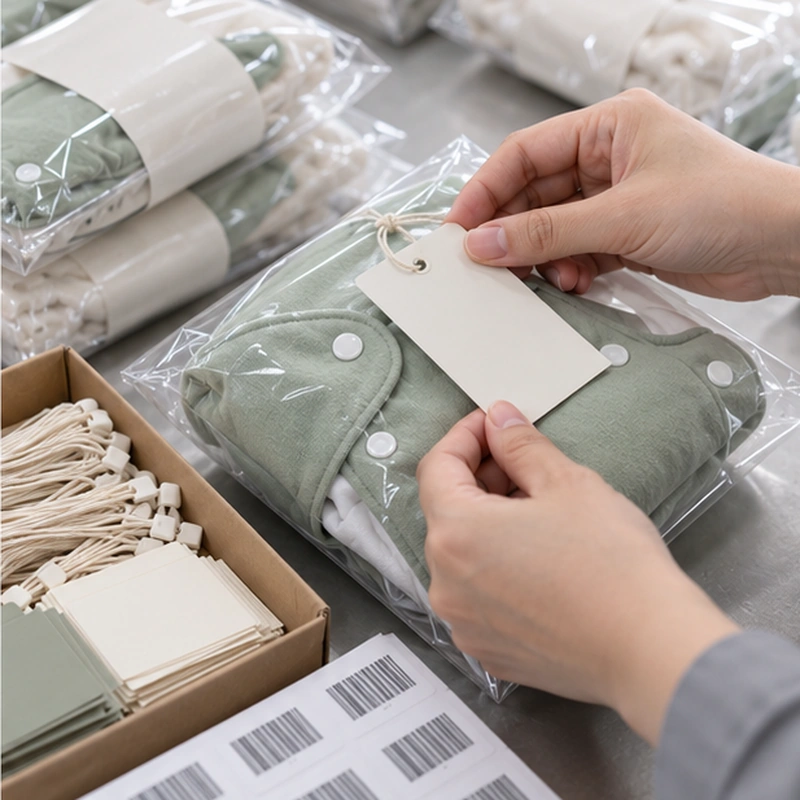
The private-label packaging workflow gives buyers a checklist for label and pack review. If the supplier shows a packaging image, confirm that it represents the quoted packaging route and not simply a visual reference. Review the product and pack as related but separate approvals.
Separate sample, production and transport schedules
Ask for a sample plan and quote independently from any custom order estimate. The sample request should identify the style, artwork, packaging and evaluation points. Custom sample work, custom production and transit should be listed separately in the commercial response. A date for one stage should not be presented as the duration of the whole project.
Confirmed in-stock styles may dispatch within two days after availability is confirmed. Dispatch is not delivery. This statement does not establish sample completion, custom-print production or transit duration. Ask for the current schedule for your defined scope and obtain a delivery estimate for the destination and chosen service. The sample-process guide explains how to review versions before a planned 500-piece order.
Use a like-for-like quote worksheet
- Exact style identifier, visual reference and written construction description.
- Quantity by product variant and confirmation of the applicable MOQ.
- Materials or blends requested by position, with unknowns marked for supplier confirmation.
- Logo file revision, product placement and requested evaluation criteria.
- Individual-pack and carton specifications, artwork revision and language.
- Sample quantity, scope, charges and approval steps as separate entries.
- Product subtotal, customization, packing, freight, exclusions and import-cost responsibility.
- Quote currency, validity date, payment terms and stated schedule for each stage.
Use the same worksheet for every offer. If one supplier has priced a stock style and another has priced a custom construction, the figures are not directly comparable. Ask what assumption needs to change before deciding. For broader product and branding context, see the manufacturing cost guide, the reusable pad range and private-label services.
Frequently asked questions
What is the price for 500 custom reusable menstrual pads?
This guide does not provide a unit price or quote. A supplier needs the selected style, specification, variant breakdown, logo and packaging route, destination and agreed commercial terms to prepare current pricing. Request itemized sample, product, customization, packing and shipping lines.
Is 500 pieces the confirmed minimum order quantity?
No. Five hundred pieces is only the hypothetical buyer-planning quantity in this guide. ReuseCare lists basic finished styles from 5 to 300 pieces depending on product; finished-product custom printing starts from 300 pieces. Confirm the minimum for the selected product and customization in the quote.
What costs should I separate in a custom pad quote?
Ask for clear lines for sample work, finished product, logo or other customization, individual and outer packaging, freight, and any destination import costs or duties that can be confirmed. Check which items are included, excluded or provisional.
Does dispatch within two days mean delivery within two days?
No. Confirmed in-stock styles may dispatch within two days after availability is confirmed. Dispatch is the handover or sending step, not delivery to the destination. This stock note does not set timing for samples, customization, custom production or transit.