
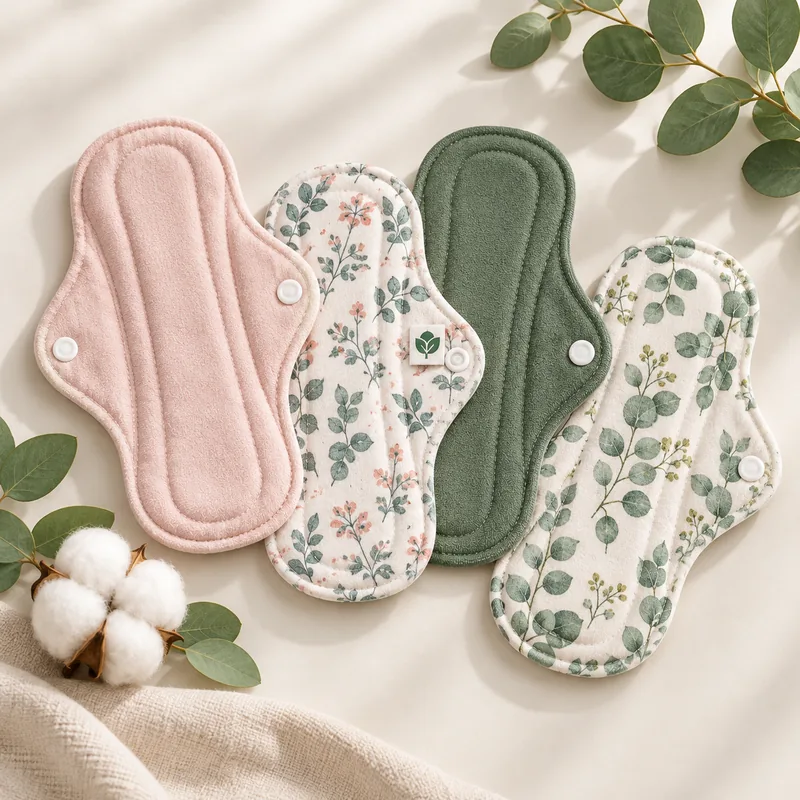
Stock inquiry: 100–250 pieces may be discussed with white snaps, subject to current inventory and confirmation of the exact style. Custom route: this product's stated MOQ is 500 pieces, with snap color options including gold. This is not a site-wide MOQ. Availability, configuration and commercial terms must be confirmed for each order.
Define what “gold snap” means for your product
“Gold” describes a requested appearance, not a confirmed component specification. It does not identify the snap's base material, finish, coating, metal content, supplier, color standard or performance. A product photograph or color name cannot establish those details. Treat the appearance as a target to review on a physical sample and request the component information required for your market and use.
Specify where the snaps sit, how many are used per pad, the preferred visual tone, and whether all units should match one reference. If you have a physical color chip or approved reference, identify it and agree the acceptable color tolerance in writing. Ask the supplier to describe the proposed snap components and attachment method; do not infer either from a product image or from the word “gold.”
Choose stock or custom around your launch plan
For an initial order of 100–250 pieces, discuss the stock route with white snaps. It can be a practical way to evaluate an existing style, pack format and market response, but stock is not guaranteed by this guide. Ask for current availability, the specific pad configuration, snap color, quantity available and dispatch assumptions. A stock discussion does not promise that every requested variant is on hand.
If gold snaps are a required part of the brand specification, plan around the custom route for this product, whose MOQ is 500 pieces. The color option should still be confirmed against the actual sample and written order specification. Ask whether the 500 pieces apply to the selected design and how any size, print, color or pack split is counted. The minimum stated here is specific to this product's custom route; other products and routes can have different minimums.
Compare the routes on equivalent terms. Record the unit being counted (individual pads, sets or retail packs), style and variant allocation, closure color, branding, packaging, sample charges, freight basis and lead-time assumptions. Do not compare a stock unit with one version of a custom retail pack until their contents are clear.
Plan 100, 250 and 500 pieces carefully
100 pieces: Request a stock check for a specified existing pad style with white snaps. State whether the quantity means pads or sellable sets, and list any day/night or size split. Ask what is available now and whether the selected pack and label are standard. If gold is mandatory, flag that the stock route described here does not provide it.
250 pieces: Keep the same stock assumptions when comparing with the 100-piece scenario. Confirm the count available, mixed-style rules, packaging and any separate pouch quantity. A target of 250 does not itself create a gold-snap stock option or establish a universal minimum.
500 pieces: This is the custom-route planning point for this product. Request a proposal for gold snap color and itemize variants, branding and packs. Confirm whether the 500-piece MOQ is calculated across the order or per style or version, and have the supplier state the accepted split in the quotation. Do not release production based on a color description alone.
Use these three quantities as planning scenarios, not promises of stock, price breaks or a single MOQ policy. Current inventory and the applicable offer need to be checked for each order.
Put closure requirements into a written specification
Before approving a purchase, buyer and seller should document the snap requirements together. At minimum, agree the visual reference and permitted color tolerance, the proposed materials for each component, attachment to the pad, opening and closing behavior, and how pull strength will be checked. State the test method, sample size, conditioning and acceptance threshold rather than relying on subjective terms such as “secure” or “strong.”
Also define post-wash inspection: washing conditions, number of evaluation cycles if relevant to the agreed protocol, drying method, what counts as discoloration, corrosion, loosening, damage or function failure, and the pass/fail rule. These are criteria to negotiate and verify; this guide does not assert any wash-cycle endurance, pull result, colorfastness, material composition, coating or certification. If a certification or restricted-substance requirement matters, identify the exact documentation and scope requested and verify it for the actual component and product.
Keep the signed specification with the quotation and sample record. If a component, source, color reference or attachment changes, require written review and a new approval where needed. The certificates and reports page can help frame a documentation request, but a general certificate does not automatically validate a particular snap component or finished pad.
Approve a sample before bulk production
Ask for a sample representing the proposed custom configuration, not merely a similar pad with a different closure. Identify the sample by date or version and record the snap appearance under agreed viewing conditions, number and placement, attachment quality, and closure operation. Review the pad construction, dimensions, sewing, label and pack contents against the same order brief.
Test opening and closing using the agreed method and inspect the attachment without assuming an unverified strength value. If wash performance matters, use the mutually agreed washing and post-wash inspection protocol. Document observations, tolerances, defects and approval status. Keep an approved reference sample or clear records so incoming goods can be compared against it. For a practical sign-off sequence, see sample approval before bulk production.
Approval should cover the complete sellable configuration: pad version, snap color reference, component information, branding, packaging artwork and included accessories. A change to any critical part should be recorded before production continues. Ask the supplier to confirm which approved sample and specification revision will govern the order.
Coordinate private label, packaging and accessories
Give the supplier brand files, label wording, logo placement, artwork revision and target market. Make clear which parts are fixed and which can be proposed. Existing pad shapes and private-label options can support a launch brief, but brand application and packaging depend on the selected design and order details. Review a physical sample and packaging proof before approval. Learn more about private-label options for existing pad styles.
If you want a waterproof storage pouch, quote it as a separate line unless a defined set explicitly includes one. State its quantity, intended use, size target, material and closure requirements, logo, packaging and whether every pad pack includes one. Confirm its own sample, minimum, availability and shipping assumptions. See the waterproof pouch guide for a separate sourcing checklist.
Prepare a focused RFQ
A useful request names the product, intended order route and destination, then asks the supplier to resolve open points. Include quantity scenarios (100, 250 and 500), unit basis, style split, required snap color by route, preferred gold reference if custom, branding, packaging, pouch quantity, sample requirement and target schedule. Ask for separate lines covering product, customization, samples, packaging, accessories and freight, with assumptions and exclusions stated.
Ask the supplier to confirm current stock, exact custom MOQ, whether mixed variants are accepted, sample timing and charge, production lead time after approval, carton data and quote validity. For the custom option, attach the agreed snap specification and make sample approval a production gate. Use the reusable menstrual pad range to identify a starting style, then send the request through the quote page.
Frequently asked questions
Can I order 100–250 pads with gold snaps from stock?
The stock route discussed here is for 100–250 pieces with white snaps. Gold snaps belong to the custom route described for this product, with an MOQ of 500 pieces. Check current stock, configuration and the exact offer for each order.
Is 500 pieces the MOQ for every ReuseCare product?
No. The 500-piece minimum applies to this product's custom route in this guide. It is not a site-wide MOQ. Confirm the current minimum for the selected product, configuration and order.
Are gold snap materials and wash performance already verified?
No material, coating, metal composition, wash-cycle durability, pull strength, colorfastness or certification is established by this guide. Buyer and seller should agree component materials, color tolerance, opening and pull checks, and post-wash inspection criteria in writing after reviewing a sample.
What should be approved before bulk production?
Approve and identify a physical sample and its snap color reference, component materials, attachment, opening and pull behavior, wash and inspection method, tolerances, label and packaging details. Record the approved version and acceptance criteria in writing.