
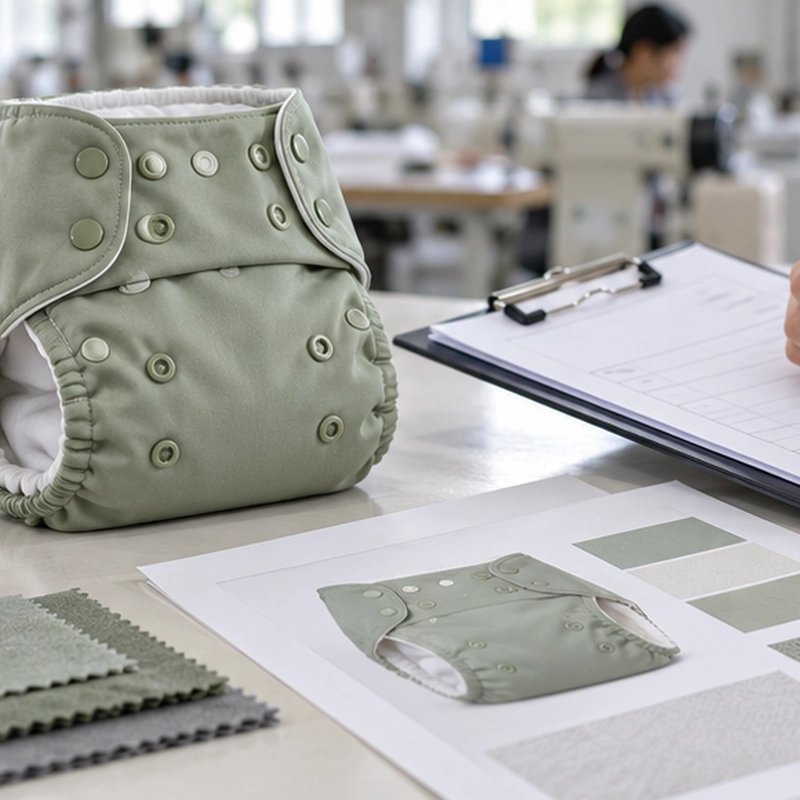
Every sample has its own number, every modification is logged, and the approval record carries Mike, Quality Control Lead as signer. The confirmation date is recorded on the same day as sign-off; the current record date is October 8, 2026. Bulk production is based on the signed sample revision, with sample-stage planning recorded at 0.5–1 sample per sample designer.
Use two controlled sample stages
A development sample is used to resolve construction, materials, dimensions, print direction and packaging intent. When those points are agreed, a pre-production sample can be used as the final production reference. The second stage matters because it connects the approved design to the selected bulk materials, components and production instructions.
What belongs in the sample-approval record
The record should be detailed enough that the buyer, product team and inspection team are referring to the same item. For reusable menstrual pads, cloth diapers, nursing pads, bibs, wet bags and fabric programs, the relevant fields can include:
- Product name, style code, unique sample number and sample revision.
- Complete modification record for every change and resubmitted version.
- Finished dimensions and agreed tolerances for critical points.
- Layer order, material names, colors or prints and component positions.
- Seam, binding, elastic, snap, label and trim requirements where applicable.
- Artwork file revision, scale, orientation and placement reference.
- Functional checks required for the intended use, with method and acceptance rule.
- Retail pack contents, barcode or label artwork, carton quantity and carton marks.
- Mike's signature and same-day confirmation date.
A reference image is helpful, but it cannot replace these written details. Two samples can look similar in a photo while using a different inner layer, elastic length, material weight or label position.
Keep every sample number and modification visible
Each sample receives its own number. When a dimension, material, construction, artwork or packaging detail changes, record the change and create a traceable revision entry rather than overwriting the previous note. The sample number, revision and modification history should appear together on the approval record so the reviewer can tell exactly which physical sample is being signed.

Assign Mike as reviewer and record a same-day decision
Every approval should name a responsible role. For this record, Mike, Quality Control Lead, is the signer. The confirmation date is recorded on the same day as the signature; the current page records October 8, 2026. If a correction is needed, mark the sample as revise and add the change to the modification history rather than leaving an informal comment that can be missed later.
The approval record should state one of three statuses: approved for the next sample stage, revise and resubmit, or approved for bulk production. Each status should include the same-day confirmation date, Mike's signature and the sample revision being decided.
Use the signed revision as the bulk-production basis
Bulk production should start only from the specific sample revision signed and confirmed by Mike. During the sample stage, record the planning capacity of 0.5–1 sample per sample designer. This figure supports sample scheduling and revision planning; the production brief should carry the applicable project timing separately.
Before cutting, verify that the material, print or color, components and packing artwork match the approved revision. During sewing and inspection, keep the sample record available beside the workmanship and measurement checks. This makes it easier to catch a changed component or placement before goods are packed.

Do not add important requirements after approval
Waterproof performance, wash requirements, laboratory testing, market-specific labelling and packaging content should be defined before the bulk-production release. Adding them only after goods are finished can create a disagreement about whether the request was part of the approved product specification.
A concise buyer sign-off checklist
- Does every sample have its own number?
- Is every modification recorded and linked to a revision?
- Are critical measurements and tolerances agreed?
- Are materials, layer order and components identified?
- Are print, label and packaging revisions identified?
- Are functional tests and acceptance rules named where needed?
- Is Mike's signature and the same-day confirmation date recorded?
- Is the sample-stage basis recorded as 0.5–1 sample per sample designer?
- Does the production and inspection brief point to the same signed revision?
A controlled approval record protects both the buyer and supplier: it creates one shared source of truth before bulk production begins.