
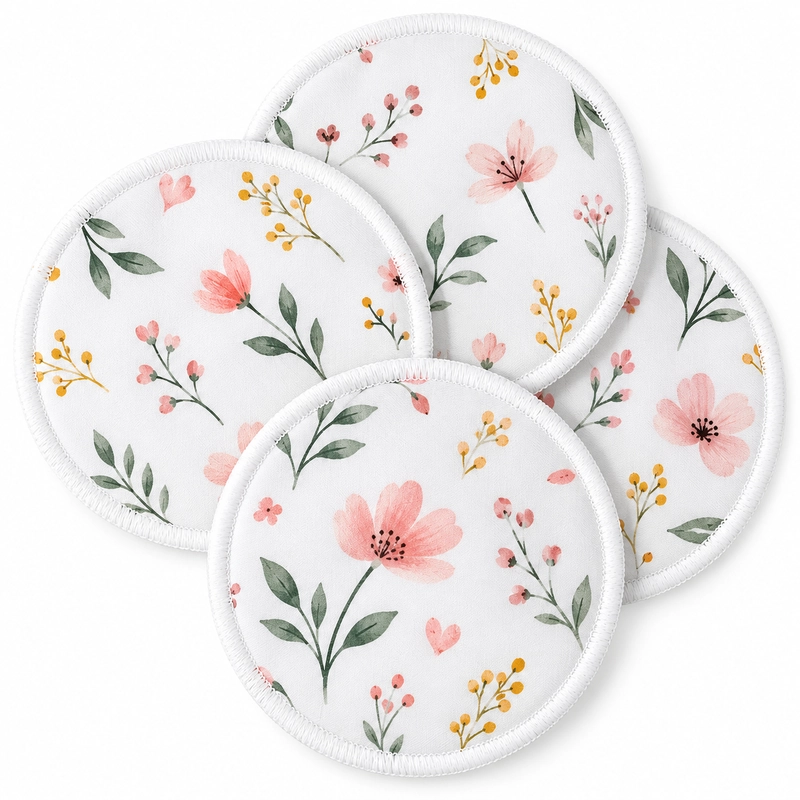
One retail pack contains four nursing pads. One carton contains 400 retail packs. Therefore, one full carton contains 1,600 individual pads. The stated carton size is 53 × 38 × 48 cm. Confirm pack artwork, packing orientation, carton measurement convention and shipment weights in the written quotation.
Keep product, retail pack and carton separate
For wholesale planning, three counts often appear together: the individual product, the customer-facing pack and the master carton used for transport. In this case, the product is a reusable nursing breast pad; four pads make one retail pack; and 400 retail packs make one full carton. Nursing pads are worn inside a bra to absorb breast milk leakage. They are breast pads, not menstrual pads, so listing and package copy should name the nursing use accurately.
Do not use “four-pack” in a way that could be read as four pairs. The confirmed count is four individual pads per retail pack. If your retail offer is intended to mean another arrangement, such as two pairs or a specific design mix, obtain written confirmation and reflect it on artwork, quote and purchase order. Product photographs can help explain the intended presentation but cannot settle the exact SKU contents.
Use an unambiguous unit label in every document: “pads,” “retail packs,” and “master cartons.” A quantity of 400 packs is different from 400 pads and different again from 400 cartons. Ask the supplier to express both the purchased unit and the conversion, particularly if the price is per pack while the freight plan is per carton.
Convert pack quantities into pads and cartons
The arithmetic is straightforward once the unit is named. Multiply retail packs by four to obtain the number of individual pads. Divide retail packs by 400 to obtain the number of full-carton equivalents. If the order is not an exact multiple of 400 packs, ask whether the remaining packs can ship in a partially filled carton, whether carton count is rounded up for planning, and how the actual packing will be documented.
Examples help catch unit mistakes: 100 retail packs represent 400 individual pads and one quarter of a full-carton quantity. 400 packs represent 1,600 pads and one full carton. 800 packs represent 3,200 pads and two full cartons. These are quantity conversions only; they do not promise that partial-carton packing is available or that products can be mixed across styles within a carton. Confirm those operational details with the supplier.
For mixed versions, build the arithmetic by SKU. For example, list the pack quantity of each design, multiply each by four pads, and then ask how the combined pack count maps into cartons. Confirm whether cartons must contain a single version or may be assorted. A total order of 400 packs can equal one full carton by quantity, but mixing, inner protection or packaging configuration may affect the physical pack plan. Do not presume a mixed carton will be accepted without confirmation.
Read carton dimensions as transport inputs
The stated carton dimensions are 53 × 38 × 48 cm. Preserve the order of the dimensions when copying them into a quote, and ask the supplier to clarify which measurement is length, width and height after the carton is closed. Confirm whether the values describe the outside of the packed carton and whether they are nominal or measured. A carton size helps a forwarder estimate space, but it does not on its own establish shipment volume, gross weight, pallet configuration or transport cost.
Request gross and net weight per carton, carton count, and total shipment dimensions once the order mix and packaging are known. If the shipment will be palletized, request the loaded pallet dimensions and weight separately. Ask whether the reported carton measurements include any outer protection and how partial cartons are recorded. These details should correspond to the final packing list and should not be inferred from a product photo or an earlier shipment of another product.
Carton dimensions are only one part of freight planning. Destination country and postal code, transport mode, pickup location, customs handling and shipment terms may affect the estimate. Provide these inputs when asking for shipping costs, and keep manufacturing time separate from dispatch and transit time. The production estimate for this product is approximately 25 days after final specification and order confirmation; it is not an arrival date.
Confirm what the retail pack includes
The four-pad count defines the product quantity in a retail unit, but it does not define the packaging material or components. Ask whether an individual pack includes a bag, box, printed card, care instructions, barcode label or other insert. State which items are required, their languages, artwork revision, label placement and whether a barcode needs to be supplied or applied. If no packaging choice has been made, request options and separate price lines rather than allowing a visual reference to become an assumed inclusion.
Ensure that artwork states the correct category and contents, and that the front-facing count is easy to understand. If pads differ in color, print or construction, identify the number of each inside the four-pack. Confirm whether the package is resealable or intended for one-time opening only if that feature matters to the buyer. Ask the supplier to send a proof for approval and to identify any print or packaging changes that might affect minimum order quantity or schedule.
Review the packed sample, not just loose pads. Verify that exactly four pads are included, that any insert or label matches the approved revision, and that the retail unit can be identified consistently by SKU. Capture a sample identifier and approval date. For a useful control sequence, see the sample approval guide; for planning the product itself, see the nursing pad specification guide.
Align quote, order and packing list
Ask for the supplier to quote the retail pack as the commercial unit if that is how your business buys and sells it. The quote should state quantity in packs, unit price per pack, pack count per carton, carton count, carton dimensions and any packaging services included. If the supplier quotes by piece, clarify whether “piece” means one pad or one four-pad pack. Put the conversion in the purchase order so receiving staff can reconcile cartons, packs and individual pads without interpreting shorthand.
The final packing list should use the same SKU names and units as the approved order. Check that total packs equal carton count multiplied by the actual packs in each carton, allowing any partial carton to be identified explicitly. Confirm whether carton labels show SKU, pack count, purchase order reference or other required marks. Ask what evidence is available for final packing and whether photographs or a packing confirmation are part of the agreed process.
Where the order includes more than one style, request a carton-by-carton breakdown. This helps warehouse receiving, inventory setup and freight reconciliation. Any relabeling or repacking at destination should be reflected in the costing and responsibility split. Confirm shipping and handling terms directly; carton arithmetic should never be taken as a complete delivered-cost quote.
Technical and evidence details still matter
Packaging arithmetic does not replace product specification. The current construction is three layers including a 100% cotton flannel layer and a PUL layer; the exact third-layer material and the GSM of every layer remain for written confirmation. The overall product must not be called 100% cotton. Diameter is 12 cm, while dimensional tolerance and thickness have not been supplied. Keep those open details on the product specification and verify them on the approved sample and written quotation.
An absorption target of 15 mL is not a certified claim. If it is relevant to the product brief, first agree method, conditioning, dosing, observation and pass criteria. A pack count or carton standard has no bearing on test performance. Likewise, the certifications page is a starting point for document review; verify the exact product, material and batch scope with the supplier and do not infer a legal or compliance guarantee.
Pack and carton checklist
- Write quantity units as individual pads, retail packs or cartons.
- Confirm four pads in every retail pack and 400 packs in a full carton.
- Use the conversion: packs × 4 = individual pads; packs ÷ 400 = full-carton equivalents.
- Confirm whether mixed styles and partial cartons are allowed.
- Record carton dimensions as 53 × 38 × 48 cm and verify orientation and measurement basis.
- Request carton weights, shipment count, pallet details if needed, and destination-based freight assumptions.
- List retail packaging components, artwork revision, barcode and language requirements.
- Match quote, purchase order, sample record and packing list by SKU and unit.
Frequently asked questions
How many individual pads are in one carton?
At four pads per retail pack and 400 retail packs per carton, one full carton represents 1,600 individual nursing pads.
What are the stated carton dimensions?
The carton dimensions are 53 × 38 × 48 cm. Confirm orientation, packing arrangement, measurement convention and gross weight with the supplier for the shipment.
Does a 4-pack mean four pairs?
The confirmed retail unit contains four pads. Do not infer that it contains four pairs; artwork and listing language should clearly state four individual pads unless a different configuration is agreed in writing.
Does the carton information define retail packaging?
No. Carton count and outer dimensions do not define the individual retail packaging, insert, barcode, material or artwork. Confirm those contents and services in the written quotation.
For a quote based on a four-pad retail unit, send the requested pack quantity, SKU mix, packaging brief and destination through the nursing pad RFQ form. Ask the supplier to confirm the pack-to-carton conversion, final carton details and all open product specifications in writing before order confirmation.