
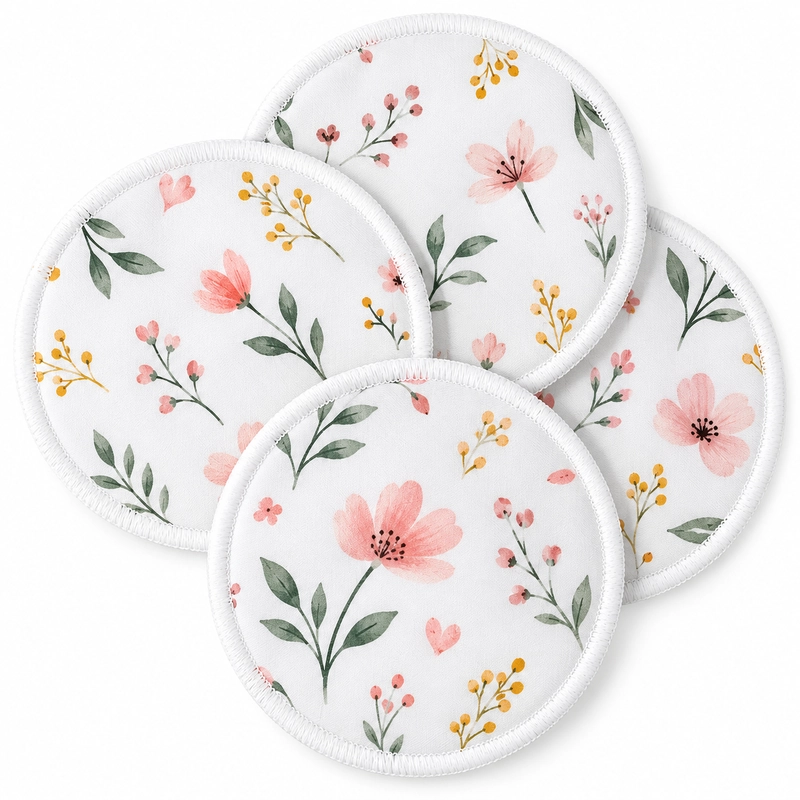
Reusable breast pads for nursing, with three-layer construction that includes a 100% cotton flannel layer and a PUL layer; diameter 12 cm; four pads per retail pack. An absorption target of 15 mL has been mentioned, but it is not a certified claim and requires an agreed evaluation protocol. Confirm the exact third layer, each layer's GSM, thickness and dimensional tolerance in writing.
Start with the product's use and shape
Nursing pads, also called breast pads, sit inside a bra to absorb breast milk leakage. They are not menstrual pads and should not be described, pictured or merchandised as such. Begin your purchase specification by naming the nursing or breastfeeding use, intended retail market, and whether the product will be sold as an individual pad, a pair or a multi-piece pack. The current pack configuration is four pads per retail pack; align listings and artwork to that count.
The confirmed diameter is 12 cm. Record the unit and measurement point explicitly, then inspect an approved sample to establish what is being measured, such as the finished edge-to-edge diameter. A nominal dimension does not state a permitted tolerance. Since no dimensional tolerance has been supplied, ask the supplier to propose and confirm one in the written specification before purchase approval. Do not add a tolerance to a purchase order by assumption.
Describe the three-layer construction without overclaiming
The confirmed construction has three layers, including one 100% cotton flannel layer and one PUL layer. This does not mean the complete nursing pad is 100% cotton. The third layer's exact material has not been provided, so it must remain open until the supplier confirms its fibre or polymer composition in writing. Ask for the layer order, which surface is intended to face the breast, and how each layer is identified on the product specification or sample record.
GSM, or grams per square metre, is a useful way to identify fabric weight, but the GSM of all three layers is currently unspecified. Request a separate value for each layer, together with any construction detail needed to make the values traceable to the sample. Avoid accepting one aggregate weight as a substitute when the purpose is to compare layer composition. Record unresolved values as “pending written confirmation”; do not let a material shorthand or photograph become the only specification.
Thickness is also unprovided. If compressed or uncompressed thickness matters to your product positioning or fit review, identify the measurement condition and request a proposed value and method. No numeric thickness or tolerance should be assumed. Review hand feel, flexibility, edge finish and visual consistency on the sample, but treat those observations as sample review rather than a substitute for a missing technical value.
Turn the 15 mL target into an agreed evaluation
Fifteen millilitres is an absorption target for discussion, not a certified product claim. A number without a method does not establish a comparable result: test conditions can change what is absorbed, how quickly it is taken up and what an observer records. Before evaluating the target, buyer and supplier should agree in writing on the method, sample conditioning, dosing procedure and rate, observation period, measurement points, and pass criteria.
Be specific about how many pads are assessed, how samples are selected, whether the amount is applied in one or multiple doses, and what counts as absorbed versus pooled or transferred liquid. Define any rest interval and the observation endpoint. Decide whether the criterion applies to every sample or an agreed sample average. Record the protocol revision and result alongside the sample version. Until those elements are set and evidence is reviewed, describe 15 mL only as a target under evaluation—not as verified performance, certification or a guarantee.
Use the sample to resolve open fields
Request a sample that corresponds to the proposed three-layer construction and the 12 cm nominal diameter. When it arrives, label the review record with date, sample identifier and supplier specification revision. Check the overall shape, diameter using the agreed measurement points, layer arrangement where inspectable, stitching and edge finish, pair-to-pair consistency, and whether the four-piece retail pack contains exactly four pads. Capture observations and photographs for internal reference.
Before approval, close the open fields: third-layer identity, each layer's GSM, thickness if required, dimensional tolerance, and absorption protocol. If any sample revision changes material, layer sequence, diameter, sewing or packaging, compare it with the last reviewed version and document the change. Use the sample approval guide to maintain a traceable approval record. The approved sample and written quotation should refer to the same final specification.
Check quality evidence and certificate scope
Review the certifications and test-report information as a starting point, then verify the exact document scope for the product and material being quoted. Check the certificate or report holder, product or material description, validity and relevant batch or transaction coverage where applicable. A document for a fabric, supplier or different product does not automatically establish that this nursing pad or a particular production batch is covered.
Ask which claims a document supports and whether the evidence applies to the exact layer materials and finished product in the approved specification. Do not treat a link or certificate logo as a legal or compliance guarantee. Requirements vary by market and claim; buyers should confirm the applicable requirements for their own product and route to market. Maintain copies of the specific records reviewed and their dates in the procurement file.
Connect construction to the quote and pack
A useful RFQ identifies the product as reusable nursing breast pads, states the 12 cm nominal diameter and three-layer construction, and lists confirmed and pending materials separately. Include the target absorption figure only with a note that its method and acceptance criteria remain to be agreed. State four pads per retail pack, expected order quantity, destination, branding requirements and sample needs. Ask for the supplier's proposed values or options for every open field, and request that the final values appear on the written quotation or specification.
Also ask the supplier to state what is included in the quoted unit: pads, retail packaging, inserts, labels and any custom work. Clarify whether quantities refer to individual pads, retail packs or cartons. Keep packaging and logistics arithmetic tied to the unit named on the quote; a quote for a pack is not automatically a quote for a single pad. For the order-unit details, see the four-pack packaging guide, and for quote preparation see the bulk RFQ guide.
Specification checklist for buyers
- Category and use: washable nursing breast pads.
- Three layers, including 100% cotton flannel and PUL; overall product is not described as 100% cotton.
- Third-layer identity and each layer's GSM: request written confirmation.
- Diameter: 12 cm nominal; tolerance still to be agreed.
- Thickness: no value supplied; request one only if required, with method.
- Absorption: 15 mL target, subject to agreed protocol and pass criteria.
- Pack count: four pads per retail pack; specify the quote/order unit.
- Sample version, labeling, destination, evidence scope and quote inclusions.
Use the reusable nursing pads product page for category context, then submit your specification through the nursing pad RFQ form. Ask for open materials, test conditions and commercial terms to be confirmed in the written quotation. Proceed against the approved sample and final written specification.
Frequently asked questions
Are nursing pads the same as menstrual pads?
No. Nursing pads are breast pads worn inside a bra to absorb breast milk leakage. They are a separate product category from menstrual pads.
Is the complete nursing pad 100% cotton?
No such overall composition claim is confirmed. The confirmed construction includes a 100% cotton flannel layer and a PUL layer; the exact third-layer material is still to be confirmed in writing.
Is 15 mL a certified absorption claim?
No. It is an absorption target only. Agree the method, conditioning, dosing, observation and pass criteria before evaluating or making a claim.
What material details remain open?
The exact third-layer material and the GSM of all layers have not been provided. Ask for these details in writing and tie them to the approved sample and quotation.