
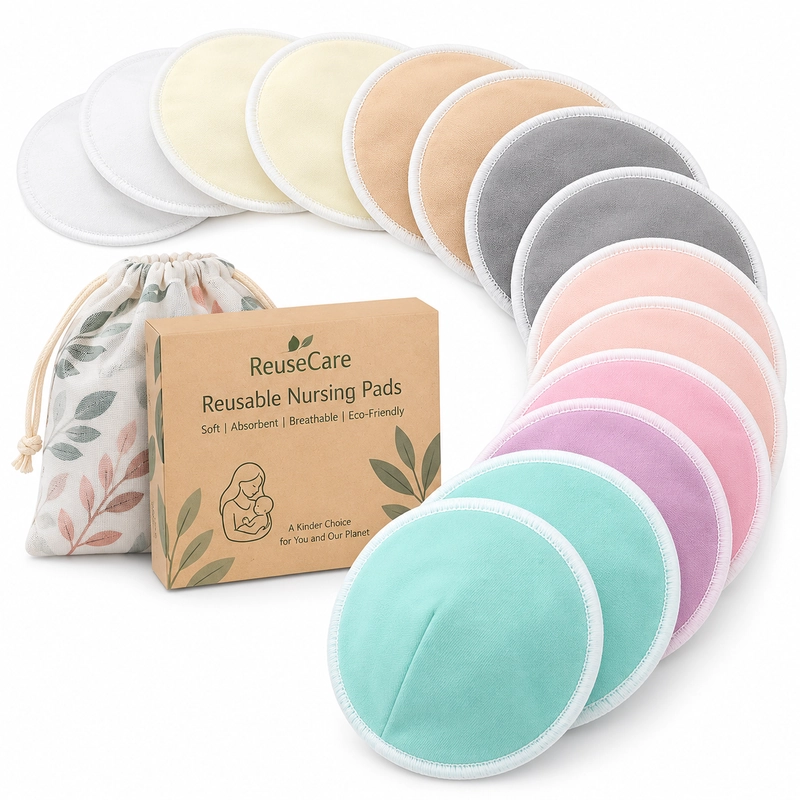
Natural and white describe how a flannel may look. They do not, by themselves, tell a buyer whether the cotton is organic, how it was processed, whether dyes or finishes are present, or whether it is suitable for a particular claim.
Begin with the retail and use context
Reusable nursing pads—also known as breast pads—are worn inside a bra to manage breast-milk leakage. This article is about breast pads, not menstrual pads. Buyers considering a natural or white cotton-flannel contact layer should first decide what the product should communicate and how the selected color will appear in the retail pack. Consider the intended brand style, the other fabrics in the design, product photography, labels and the appearance expected after care.
A natural-looking textile may align with a muted, undyed aesthetic. A white-looking textile may fit a clean or minimal palette and make the contact surface visually distinct. These are merchandising choices, not technical conclusions. The words “natural,” “undyed,” “unbleached,” “white” and “organic” are not interchangeable. If a label, marketing statement or sourcing policy relies on one of them, define the intended meaning and ask the supplier for evidence tied to that exact material.
Color on a screen is a weak approval reference. Lighting, image processing, display settings and nearby colors can change perceived shade. Request a physical swatch or finished product sample and approve the actual material under consistent lighting. Record the chosen shade, material identity and sample revision together so a later purchase can be compared against a clear reference.
What “natural” and “white” do—and do not—tell you
“Natural” is often used commercially to describe an off-white or uncolored appearance. Unless specifically defined, it does not establish that the fabric received no processing, contains no finishing agents, is organically grown or meets a particular standard. Ask the supplier what the word means in the offered specification. If the buyer needs an uncolored fabric, make that a clear requirement and request confirmation of the proposed processing and available documentation.
“White” describes a visible result. It does not prove the fabric was bleached, nor does it reveal which process or chemistry may have been used. A buyer who needs to know the finishing route should ask directly and obtain a written response for the nominated material. Do not infer the answer from the shade, product photograph, sample alone or a general certificate held by the supplier.
Neither color description establishes softness, absorbency, durability, odor, skin compatibility or product safety. Those topics require their own defined criteria and evidence. Avoid unsubstantiated language such as “hypoallergenic,” “chemical-free,” “non-toxic” or “safe for all skin” based only on a cotton name or light color. Review the certification and document information and check each document’s validity and scope for the exact fabric, finished product and batch where applicable. No certification page should be treated as a blanket legal or compliance guarantee.
Fit the choice to the confirmed nursing-pad construction
The current confirmed starting specification is a three-layer nursing pad including a 100% cotton flannel layer and a PUL layer. The product has a stated 12 cm diameter and a four-pad retail pack. The whole product must not be described as 100% cotton: the flannel layer is 100% cotton, while PUL and a third layer are also part of the construction. The third layer material and the GSM of all layers remain open and require written confirmation.
When requesting natural or white flannel, clarify which layer is being discussed and whether the request concerns the breast-facing contact surface. Separately confirm the PUL position and third layer. Ask for fiber composition, fabric construction, GSM, color description and any relevant finish for each material. A color approval does not approve the rest of the layer map, and a layer map does not automatically approve the shade. Treat these as separate fields in the specification.
If a supplier offers multiple flannel variants, avoid comparing an unwashed swatch with a finished, washed product or different fabric weights side by side as if color alone explains the difference. Ask for comparable samples and note any pre-treatment or care history the supplier can confirm. The guide to flannel and PUL layer roles explains why those materials are complementary rather than direct alternatives.
Make color approval reproducible
For a trade order, “white” can still be too broad. Define a physical master swatch, approved sample or other mutually understood color reference. Document the reference ID, date, material name and location in the construction. If a numeric color target is important, identify the system and tolerance jointly with the supplier; do not invent a target by measuring a web image. Confirm whether variation between fabric lots is acceptable and how it will be evaluated.
Check a submitted sample under the same lighting and viewing conditions used for approval. Inspect the front and reverse, seams, edge finish and appearance in the retail pack. If products are sold as pairs or four-pad sets, check whether the pieces look acceptably consistent together. Agree how the supplier will handle shade variation between production lots before bulk production. Include the approved master’s handling and retention plan in the sample record.
Color is only one approval gate. Confirm the pad’s 12 cm diameter against the agreed measurement method and ask for a dimensional tolerance; none is supplied in the current starting details. Thickness is likewise not specified. Do not make either a numerical tolerance or thickness assumption. Add these values only after buyer and supplier agree the method and acceptance range in writing. The sample approval workflow can help keep physical approval linked to the version quoted.
Separate appearance from performance claims
The product’s stated absorption target is 15 mL. This is a target, not a certified claim or verified result. There is no supplied test method. If a buyer intends to publish a capacity or absorbency statement, first agree conditioning, fluid, dosing, observation, measurement and pass criteria, then obtain results for the specified construction. Color does not predict the test result and should not be used as a proxy for performance.
Likewise, neither natural nor white appearance proves a pad will resist leakage, retain a specified amount, stay a certain color after washing or remain unchanged over a claimed lifespan. State the required outcome and establish how it will be assessed. If the contact layer, finish, GSM or other construction detail changes, confirm whether the old test evidence still applies.
Keep product copy precise: say “includes a 100% cotton flannel layer” when supported by the confirmed specification, and identify other layers where relevant. Avoid “100% cotton nursing pad,” “hypoallergenic cotton,” or claims about bleaching or chemical processing unless exact evidence supports the statement and the claim is reviewed for the intended market. Ask the supplier for evidence and have the buyer’s responsible team assess whether it supports proposed packaging language.
Commercial and packaging details
The current pack format contains four pads. The stated carton measures 53 × 38 × 48 cm and contains 400 retail packs. A sample is US$30 with an approximate three-day lead time. Bulk production is approximately 25 days after final specification and order confirmation. Confirm those points in the written quotation for the precise color, style, quantity and packaging requested. Lead times and packing should not be assumed to cover an unapproved custom material or additional verification.
Send the requested color, material identity, layer map, 12 cm target diameter, four-pad pack and open performance questions together. Ask the supplier to note the third layer, all GSM values, thickness and dimensional tolerance as pending until written agreement. The reusable nursing-pad page provides the starting product details, and the resource library includes related sourcing guides.
Buyer checklist
- Choose a physical natural or white appearance reference.
- Define what “natural,” “white,” “undyed” or any claim means.
- Confirm the exact flannel layer and its fiber composition in writing.
- Obtain the third-layer material and GSM for all three layers.
- Do not infer processing, hypoallergenic status or performance from color.
- Set any thickness and dimensional tolerances with a method and acceptance range.
- Approve a sample and link it to the quote and retail artwork.
Submit your preferred color and technical questions through the nursing-pad RFQ form; request written confirmation before approving production.
Frequently asked questions
Does natural cotton flannel mean unprocessed or organic?
No. Natural is a color or appearance description unless the supplier defines it otherwise. It does not establish organic status, a particular processing history, or a certification.
Does white flannel prove that the fabric was bleached?
No. Appearance alone does not confirm the process used. Ask the supplier to identify the finish and provide supporting information relevant to the exact material if that detail matters to your brief.
Is either option hypoallergenic?
No hypoallergenic claim is established here. Do not infer a health or skin-suitability claim from color or fiber name; request relevant substantiation and review applicable requirements for your product and market.