
Flannel describes a textile surface; PUL describes a laminated material layer. One may provide the breast-facing contact surface while the other is part of the barrier construction. Neither name alone defines finished-pad absorption, comfort, leak performance or care life.
Different materials, different functions
A reusable nursing pad, also called a breast pad, sits inside a bra to manage breast-milk leakage. This guide concerns breast pads only; it does not describe menstrual pads. Buyers comparing materials should first identify where each fabric sits in the finished article and what job it is expected to perform. “Flannel versus PUL” can be a misleading framing because the materials can coexist in one layered product.
Cotton flannel is a woven cotton fabric with a brushed surface. For the current product option, the confirmed description is a 100% cotton flannel layer. If selected as the breast-facing side, it is the named textile contact layer. That fact does not establish a particular softness grade, absorbency quantity, skin response or care durability. Those depend on the actual fabric, finishing, construction, laundering and the buyer’s criteria.
PUL is commonly used to describe a fabric construction incorporating a polyurethane laminate. In this confirmed nursing-pad option, a PUL layer is part of the three-layer build. Its role in the layer system is different from the flannel face: it is the barrier-associated layer. However, simply naming PUL does not prove a finished sewn pad meets a particular leakage threshold. Construction, seams, fit and test conditions matter. Buyers should ask for the exact layer orientation and the evidence available for the product version being purchased.
Why buyers should not choose only one
A contact surface and a barrier layer answer different product questions. Flannel is a surface fabric choice; PUL is a distinct layer choice within the assembly. Removing either could change how the pad feels, handles moisture or functions in use. It is not reasonable to assume the buyer must select flannel or PUL as mutually exclusive alternatives. A more useful brief names the intended breast-facing material and separately identifies whether the construction includes a PUL layer.
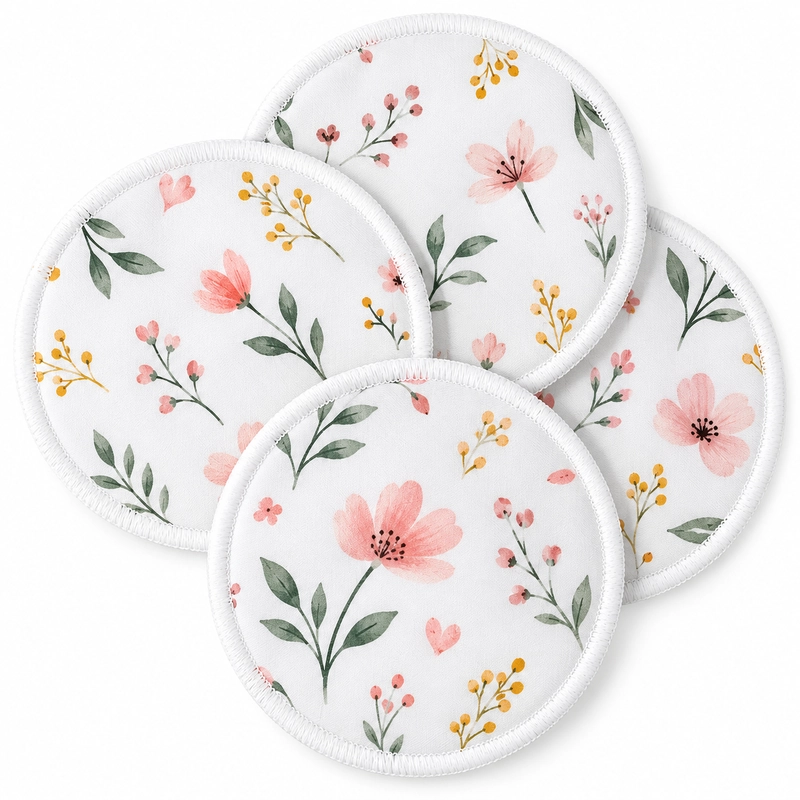
This separation also improves quotation comparison. Ask each supplier to map the layers from breast-facing side to bra-facing side, identify each material, and state which descriptions are confirmed versus proposed. An image of a printed pad may show its outward appearance but cannot reliably establish the inside stack. For broader layer terminology, see the reusable-pad materials and layers guide; remember that the nursing-pad specification must be confirmed for the breast-pad product, not inferred from another category.
What the current confirmed starting specification says
The current confirmed starting option is a three-layer reusable nursing pad with a 100% cotton flannel layer and a PUL layer. Its stated diameter is 12 cm, the retail pack contains four pads, and the absorption target is 15 mL. That 15 mL figure is a target for discussion, not a certified or independently validated performance claim. A reproducible method, conditioning, dosing, observation and pass criteria have not yet been supplied and must be agreed by buyer and supplier.
The third layer material and the GSM of all three layers are open and must be confirmed in writing. Do not read “100% cotton flannel” as a statement about the whole product: the overall product must not be called 100% cotton because it includes PUL and has an unconfirmed third layer. Ask for exact fiber composition and layer names for the full assembly. Also confirm whether a nominated textile refers to a face, backing or core, since those positions are not interchangeable.
Thickness and dimensional tolerance are also unspecified. If those affect fit, shelf presentation or performance claims, add an agreed measurement method and acceptance range to the specification rather than relying on a visual estimate or a generic industry value. For production, a written specification should tie the material map, sample version, artwork, packaging and any test criteria to the same item code.
Turn material descriptions into checkable sample criteria
Before sampling, create a simple layer table with position, material name, composition, GSM and supplier confirmation status. Use “pending written confirmation” for the third layer and GSM values. Ask for the supplier’s proposed values and do not approve them until your team accepts them. State the flannel face orientation and how the PUL layer is positioned in the pad. Where the production method or finish could affect the nominated surface, request a sample that represents the final proposed construction.
On sample receipt, check the declared materials against labels or supporting records provided for that exact material. Examine the pad’s shape, stitching, finish, both faces, and pack count. A sample inspection can establish what you received; it cannot by itself establish chemical safety, legal conformity or long-term wash performance. Keep the approved sample identified by date and revision, and record any changes before bulk production. The sample approval guide explains how to track sample versions and written sign-off.
If a certificate or test report is relevant to your market or sourcing policy, view the available information at Certifications and verify the document holder, validity and exact product, material and batch scope. A certificate displayed by a supplier does not automatically cover every fabric or finished nursing pad. Do not treat this article or a general product page as a legal or compliance guarantee.
Connect materials to the agreed performance question
Ask what the 15 mL target means in a controlled test. The buyer and supplier should agree fluid type, sample conditioning, dosing location and rate, delivery equipment, time between doses, observation period, measurement approach, repetitions and pass/fail rule. If the intended question concerns leakage, define what counts as leakage and where it is observed. If it concerns retained fluid, define how gain or transfer is measured. Those are different outcomes and should not be conflated.
Run the agreed procedure on an identified sample construction, then record the date, sample revision, method and observations. If any layer, fabric weight, finish or sewing detail changes, decide whether the result still applies. Until method and criteria are agreed and results recorded, phrase 15 mL only as the product’s absorption target—not as a certified result, universal capacity or performance guarantee.
Commercial details to place in the RFQ
The current pack format is four pads per retail pack. The stated carton is 53 × 38 × 48 cm and contains 400 packs. A sample is US$30 with an approximate three-day lead time. Bulk production is approximately 25 days after final specification and order confirmation. These are planning inputs; have the written quotation confirm the applicable style, quantities, packing, timing, freight and any open conditions. Do not assume that the carton or lead time applies unchanged to every customization.
When requesting a quote, include the target contact layer, three-layer structure, pending material/GSM questions, 12 cm diameter, four-pad pack, absorption target and required test discussion. Ask for open points to be returned in writing and verify the approved sample against the quotation before placing a bulk order. Browse the reusable nursing-pad product page for the starting option and the resource library for additional buyer guides.
Buyer checklist
- Identify this product as reusable nursing pads or breast pads.
- Confirm flannel as a 100% cotton layer and identify its face orientation.
- Confirm the PUL layer position and the third layer material in writing.
- Obtain the full layer map and GSM for each layer; do not assume values.
- Agree any thickness, dimensional tolerance and measurement method.
- Define a reproducible test if using the 15 mL target.
- Approve a traceable sample and match the quotation to that version.
Use the nursing-pad RFQ form to share your target specification and ask for written confirmation of open details.
Frequently asked questions
Are cotton flannel and PUL alternatives to each other?
They serve different roles and can be used together. Cotton flannel is the confirmed contact-layer material in the current starting specification; PUL is a separate layer in the three-layer construction. Confirm orientation and the complete layer map in writing.
Is the whole nursing pad 100% cotton?
No such claim is supported. The confirmed specification is a three-layer pad that includes a 100% cotton flannel layer and a PUL layer. The complete product must not be described as 100% cotton.
What should I confirm before ordering?
Confirm the third layer material, each layer's GSM, orientation, finished dimensions and tolerance, and the agreed absorption test method and acceptance criteria in the written specification.