
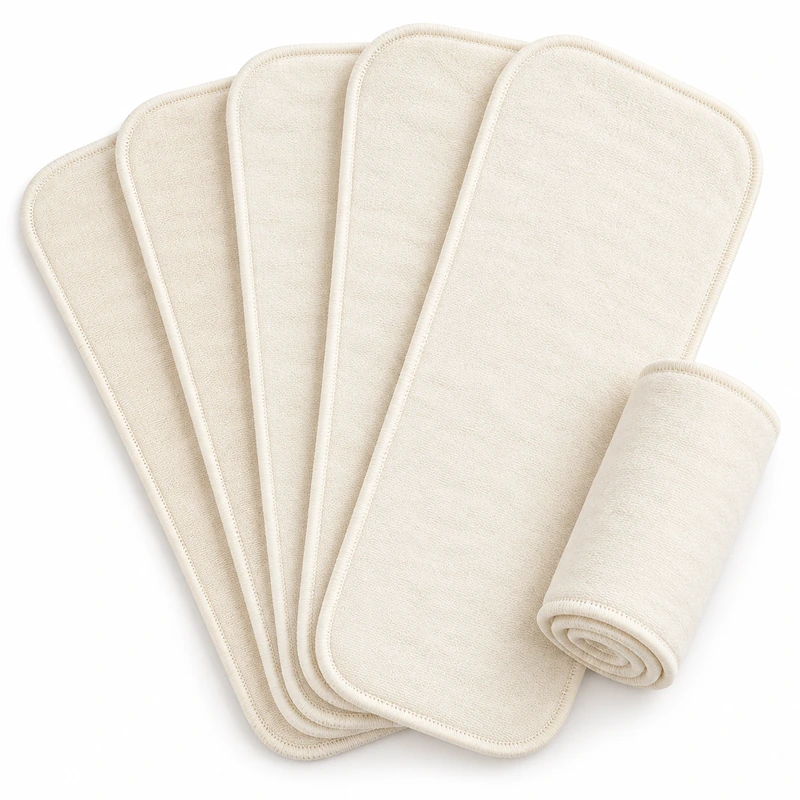
Run a comparison with a fixed sample brief: hold pattern, target finished dimensions, layer count and evaluation method constant where possible; change one material variable at a time. Record what the supplier confirms, what you observe, and what remains unverified. This reveals useful trade-offs without implying that a fiber name guarantees a particular performance.
What the insert catalog shows—and what it does not
The table below summarizes product-card names and visible presentation only. The names help identify a reference sample; they do not confirm its fiber declaration or construction.
| Catalog candidate | Visible/catalog fact | Confirm before comparison |
|---|---|---|
| Bamboo | The catalog names a “Bamboo Diaper Inserts — 8 Pack” style and shows light-colored inserts together. | Exact fiber blend and percentages; which layer(s) use that fabric; total layer count; finished dimensions and shape. |
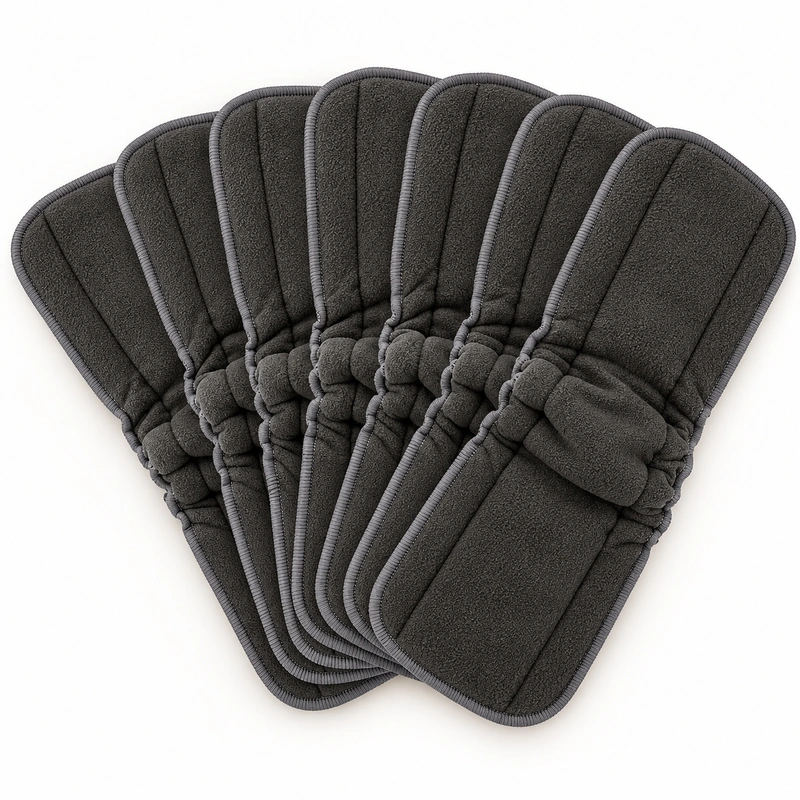
| Bamboo charcoal | The catalog names a bamboo-charcoal insert style and shows eight charcoal-colored pieces together. | Whether “bamboo charcoal” describes a face fabric or another component; declared composition and position; complete layer sequence; shape and dimensions. See the dedicated charcoal specification guide. |
| Hemp & cotton | The catalog labels a natural-tone style “Hemp & Cotton Diaper Inserts.” | Hemp and cotton proportions, fabric type and layer position; other materials in the build; layer count; finished shape and dimensions. |
| White | The catalog shows a white insert reference folded and rolled. | Fiber composition (white appearance does not identify fiber); whether shown forms are the same style; layer structure, dimensions and edge construction. |
| Gusseted charcoal | The catalog names a gusseted charcoal insert and visibly shows a shaped/gusseted profile. | Material blend and position; how the gusset is formed; layer count; finished dimensions and tolerances. Treat shape as a separate variable from material. |
Pack counts and visual arrangements describe the pictured/catalog reference only. Ask the supplier to confirm the offered sample and quoted configuration for the specific item.
Choose the decision criteria before requesting samples
Start with the product’s intended role in your range and the trade-offs your team needs to resolve. Possible criteria include hand feel, bulk in the intended diaper, ease of handling when wet, drying workflow, construction stability and your own defined absorbency or laundering evaluation. These are buyer questions, not claims about any pictured material.
Rank each criterion as required, preferred or informational. Name the reference diaper or pocket, fitting method, care routine and evaluation conditions you will use. If a criterion depends on a performance result, agree a method and acceptance rule with the supplier before the sample arrives.
Make a controlled sample set
- Identify candidates. Give every proposed sample a code. Request its declared fiber blend, fabric type, layer position and construction in writing.
- Hold other variables steady. Where feasible, compare candidates made to the same pattern, finished dimensions, layer count and edge finish. If those differ, note the difference; do not attribute the result to material alone.
- Measure and document. Use agreed measurement points and tolerance. Record dry weight only if it matters to your decision, using an agreed conditioning and weighing procedure.
- Run your defined checks. Apply the same preparation, liquid or wash method, timing, support and observation criteria to each sample. Keep raw observations with the sample ID.
- Repeat and decide. Repeat checks as agreed, note variation, and select against your ranked criteria. Record unresolved risks rather than converting a limited sample observation into a general claim.
Example: shortlist candidates without assuming a winner
Illustrative buyer scenario, not a ReuseCare test result: a brand wants to choose a material direction for one pocket-diaper insert. It requests bamboo, bamboo-charcoal and hemp-and-cotton candidates, but asks the supplier to use one agreed pattern, target dimensions, layer count and edge finish wherever feasible. The supplier must declare any unavoidable differences before sending samples.
The buyer labels the candidates A, B and C and records the supplier-confirmed blend and layer map for each. Before comparing them, the buyer checks whether dimensions and construction match the shared brief. A sample that differs in shape or layers is marked “not like-for-like” and moved to a separate fit review. The buyer fills in the same agreed evaluation method and its own observations for every candidate; this example supplies no outcome.
| Sample | Supplier confirmation | Buyer observation | Status |
|---|---|---|---|
| A — bamboo reference | Blend, layer positions/count and deviations: pending | Enter only after the agreed check | Pending review |
| B — charcoal reference | Meaning of label, blend, positions/count and deviations: pending | Enter only after the agreed check | Pending review |
| C — hemp/cotton reference | Blend proportions, positions/count and deviations: pending | Enter only after the agreed check | Pending review |
If the team also wants a gusseted version, review it in a separate shape/fit stage so a changed profile is not mistaken for a material effect.
Use a comparison record buyers can act on
| Record field | What to enter | Decision use |
|---|---|---|
| Sample identity | Code, revision, received date and supplier reference | Prevents comments being applied to the wrong version |
| Declared construction | Blend, fabric type, layer position, count, pattern and edge finish | Separates a material change from a build change |
| Method | Preparation, measurement points, wash or functional procedure, repetitions | Makes the comparison repeatable |
| Observation | Measured value or direct observation, conditions and reviewer | Keeps evidence tied to the tested sample and method |
| Decision | Ranked criteria, accepted trade-offs, open questions and next action | Creates a clear basis for the next sample or quote |
Do not let one check stand in for another
A dry hand-feel review cannot establish absorption. An absorption comparison under one setup does not establish wash durability. A fabric result does not automatically establish finished-insert behavior. State which question each check answers and retain its conditions. If the construction changes after selection, review whether the relevant checks need to be repeated.
For reusable products, agree laundering conditions and post-wash observations before testing. Record dimensions, seam condition, shape and appearance only against the criteria your project has defined. Avoid claims about service life or performance unless your evidence supports the exact finished product and intended claim.
Turn the selected sample into a quote basis
Send the selected sample code and revision with its confirmed construction, finished dimensions and tolerance, target quantity, pack configuration, label or artwork needs and destination. Ask the supplier to identify any substitutions or open items in the quotation. ReuseCare’s product page describes sizes and absorbency structures as configurable and asks buyers to confirm final construction against the product; exact commercial terms depend on the selected style and project.
Browse the cloth diaper insert range to identify candidate styles, then use the insert inquiry form to share your comparison brief. For a named charcoal option, use the linked bamboo-charcoal guide to document composition and layer positions.
Buyer checklist
- Rank your intended-use criteria before sampling.
- Assign a code and revision to every candidate.
- Ask for written material declarations and construction details.
- Hold pattern, dimensions and other variables steady where possible.
- Agree measurement, absorption and laundering methods before comparison.
- Record raw observations with method, date and reviewer.
- Document the selected trade-offs and remaining questions in the quote brief.